There can be little doubt of the importance of continuing professional development (CPD) for teacher practice. Effective CPD leads to changes in teacher knowledge and practice and supports student learning outcomes (Darling-Hammond et. al.,2017). But the format of the experience matters. There is consensus around features of effective CPD, including being content focused, incorporating active learning, supporting collaboration, providing expert support and being of sustained duration.
The Science Museum has been delivering teacher CPD for over 20 years, and has commissioned research to better understand the impact of this training. The SMG Academy courses currently offer training in engagement approaches that can be applied across STEM (science, technology, engineering, maths) subjects and beyond and are one-off workshops.
Can they have an impact? Our research set out to explore this possibility. Over the course of several months, 29 teachers were interviewed, and a further five were observed putting the training into practice in their schools. There was substantial variation in the teacher backgrounds- number of years teaching, school types and ages of pupils taught. Teachers had also attended a range of Academy courses, though all had a focus on engagement.
Data analysis was rooted in Guskey’s five levels of evaluation of professional development: 1) Participants’ reactions, 2) Participants’ learning, 3) Organisation support and change, 4) Participants” use of new knowledge or skills, 5) Student learning outcomes. This research specifically emphasised levels 4 and 5.
Content vs Pedagogy
SMG Academy training is founded on the Science Museum Group’s extensive experience engaging audiences with science and technology through its exhibitions, public programmes, interactive galleries and collections. These engagement approaches have also been shaped and informed by research around science capital and wider education research. This foundation leads to the Academy’s deliberate focus on engagement, or pedagogical approaches that are not subject-specific, rather than on content.
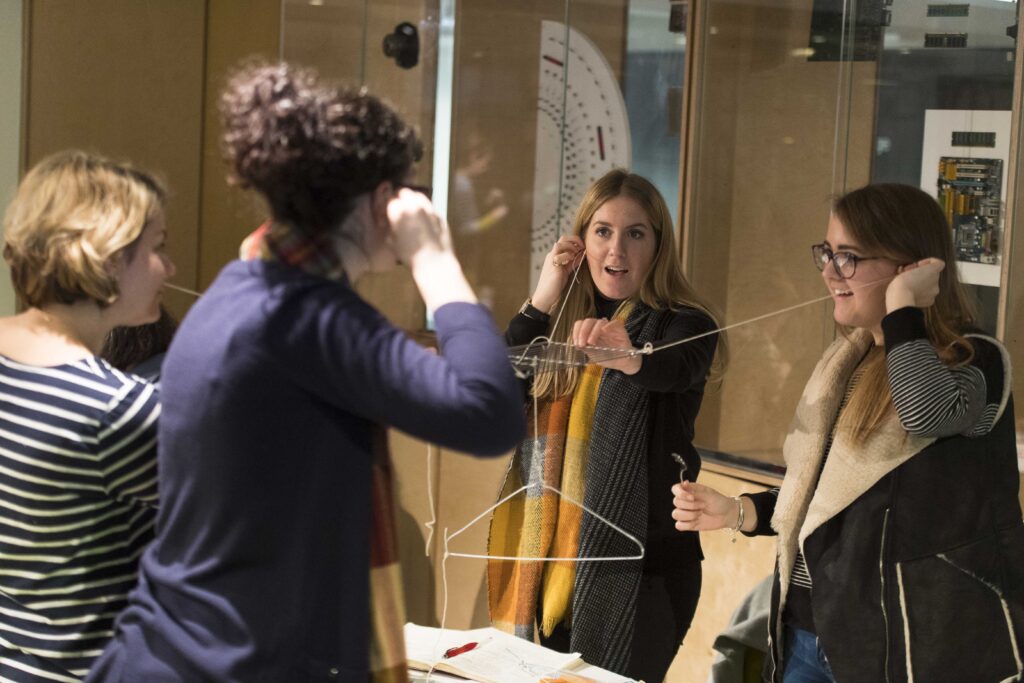
While pedagogy does not exist in a vacuum and the courses are taught in the context of STEM teaching, the tools and techniques can be applied to many subjects. In focussing on engagement- or how teacher practice can more effectively engage pupils, the Academy plays to the strengths of the SMG staff and the Group’s reputation as experts in engagement. Moreover, when the trainings are delivered onsite, there are ample opportunities to try out the techniques in a distinctive setting, which can enhance teacher enjoyment of the day and feelings of inspiration.
The one-off training
A body of research on teacher CPD (eg. Darling-Hammond et al., 2017) highlights
that sustained professional development experiences strengthen impact, leading to a consensus view that a one-off training cannot have impact. However, the Academy’s focus on techniques to engage pupils actually seems to make impact more likely. The techniques are adaptable- and teachers are encouraged not only to try out activities and approaches on the day, but also to think about how they might try them back in their classrooms, with their pupils.
Moreover, because they are adaptable, there is no need to master them in the course of a day- just a taster was enough to act as a spark for teachers to try them back at school. This adaptability also increased the possibility that teachers would implement the approaches in their classrooms, which served to embed the training into their practice, making impact more likely.
The SCIENCE MUSUEM GROUP AND Academy niche
As part of the research, we conducted a review of the science CPD landscape in England. This highlighted that the SMG Academy’s focus on pedagogical strategies to improve engagement, rather than on specific content areas, is distinctive. Additionally, teachers reported that compared with other CPD, the opportunity to engage with objects from the collection (and replicas) and exhibits in the museum (when delivered onsite), as well as a tasty free lunch, added o the distinctiveness of the training, and, importantly, made teachers feel valued.
impact?
All of the above together meant that we saw teachers implementing the tools and techniques, as impact on students’
behaviour and engagement, and an impact on teachers themselves- a powerful combination. Data from the interviews and observations demonstrated an impact on teacher practice, as only five had yet to implement approaches from the training, due to lack of opportunity (e.g. timing, being a trainee teacher). Every teacher who had implemented the tools and techniques remarked on their impact on pupil engagement:
“In the moment, it’s particularly when they’re doing group work, they’re all very much on task and they’re all talking about what you want them to talk about rather than them just having a random off topic chat.”
Teachers also reported impacts on pupils’ content knowledge and, often quite movingly, on their confidence, which was particularly important for pupils who struggled academically or those with special educational needs. Teachers attributed this to the emphasis on discussion and open questions (without right or wrong answers), which gave students a change to feel their voices were being heard:
“I have a challenging behaviour class, as I say, with lots of needs… It does help giving them more time to talk and discuss. It means that you know they feel that their voices are being heard a bit more.”
Interviews also revealed impact not only on teacher practice but also on teacher mindset. We saw increased valuing of discussion and open questions, valuing of relevance and linking to student interests, and generally becoming more student-centric, rather than curriculum-centric, despite the pressure of assessments and an overloaded curriculum.
Lessons for other culTUral institutions
The findings from our research also have implications for other cultural institutions who might offer teacher CPD, or considering doing so.
Focus on engagement: Whilst links to curriculum are important, teachers don’t expect you to be experts in every topic included in their schemes of work. It’s better to focus on approaches to support pupil engagement that are applicable across broad subjects areas (ie. science, history…)
Play to your strengths: Such as in engaging audiences, and leverage what you can distinctively offer, such as your collections or a chance to visit galleries.
Support active learning and reflection: Giving teachers a change to try out the techniques and reflect on how they would adapt them to their pupils.
Against conventional wisdom, a one-off CPD can make a difference!
What to read next
Exploring Science Through Play: Developing a new training course for early years educators