The Science Museum Group (SMG) have been developing activities and resources to help engage young children museum collections and their stories – in and beyond our physical sites .
One of these new resources is an image bank of ‘curious things’ which is a set of beautiful images, and questions, of some the more unusual and playful objects which can be found in our Science Museum Group collection.
What is the idea behind the Curious Things image bank?
Lily… The idea behind the Curious Things image bank was to harness the natural curiosity and imagination of early years children using images of the amazing objects from our SMG collection in a fun and approachable way.
Who is the image bank aimed at?
Pete… The image bank is aimed at children age 4 to 7 and their teachers and families to use either at school or at home. Alongside the pictures, the image bank includes question staters to help spark imagination and curiosity and to invite them talk about amazing objects.
what were you looking for in the choice of objects for this resource?
Lily… It was a bit challenging at first, partially because we were looking for museum objects to specifically engage an early year’s audience. But we had a lot of fun exploring the collection and trying not to think too much like an adult!
Pete… We were helped by our early years and learning project research findings which had identified the types of objects younger children find interesting which included objects that are brightly coloured, familiar, big or small, precious looking or are funny or surprising. This gave us a good starting point for the types of objects to start looking for.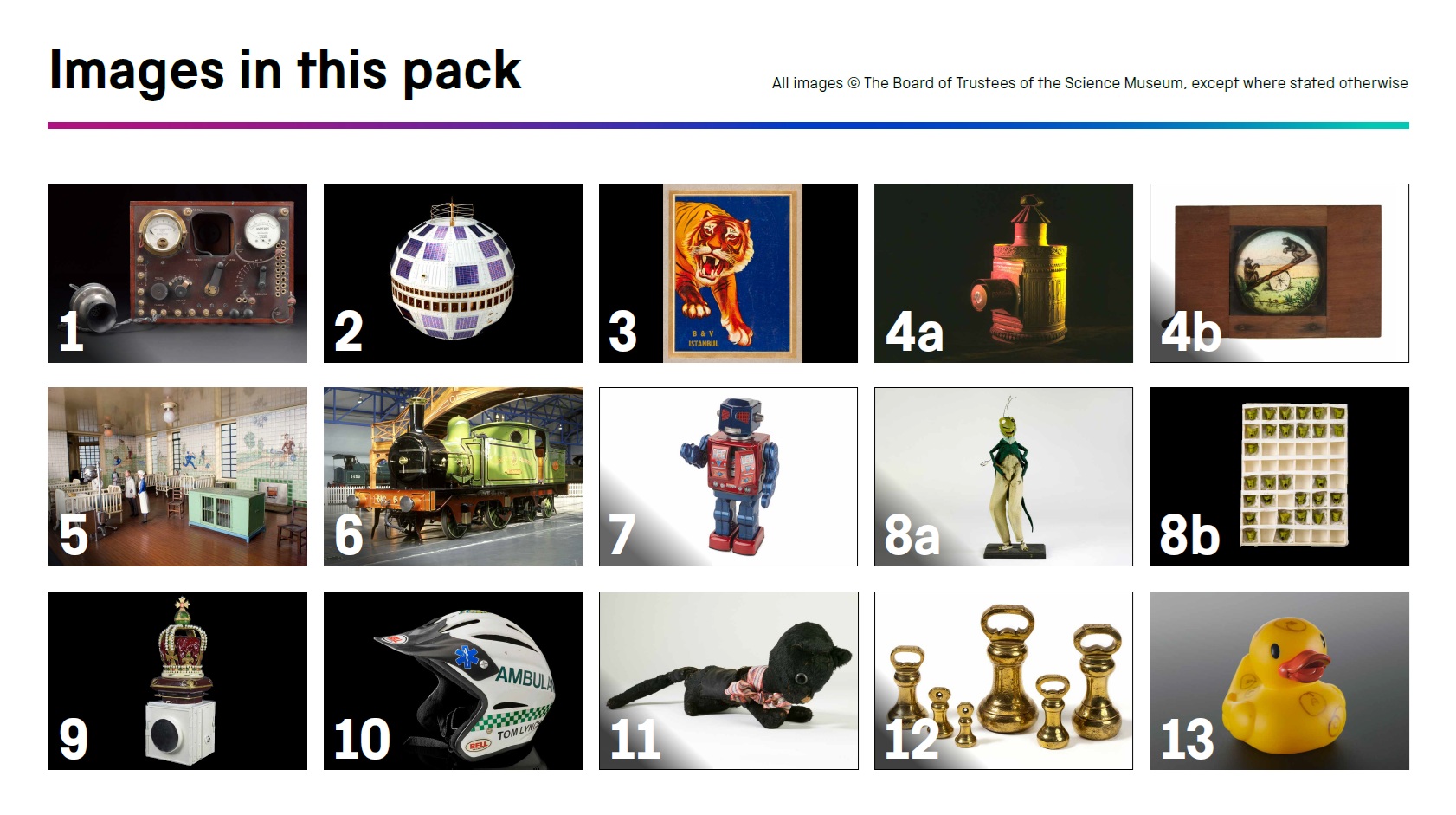
how DID you GO about developing the image bank?
Lily… Using what we’d learned from the early years research and having an idea for what younger children are drawn to, we pulled together a big spreadsheet of all the collection objects that we though could be interesting for that age group.
Once we’d narrowed it down to a list of fifteen objects, we sought the input of the wider team through a series of ‘pin up’ sessions where they shared their thoughts on the shortlisted objects. It was really interesting to hear everyone’s different opinions on them, and how everyone thinks about objects a different way. We went through this process a few times until we agreed on the final selection.
DID YOU ENCOUNTER ANY challenges ALONG THE WAY?
Pete… At the start I think we struggled with picking objects that were story led rather than visually led. We realised that if you have to explain an object for it to be interesting, then it isn’t really a strong enough object for an image bank.
It took time for us to shift our mindset and get out of the habit of approaching objects with an adult eye.
What did you enjoy about developing the image bank?
Pete… Being able to look through some of the weird and wonderful objects that we have in our object collection at SMG. Some things really made us think… what is that, and why does it exist?
Lily… Another was putting yourself into the mind of a 5 year old and thinking “what are they going to like?”, “what are they going to engage with?” I went into this project really struggling to understand early years and now I’ve come out feeling much more confident in how to approach that audience.
did anything surprise you during development?
Lily… I definitely think the surprises were largely from the difference between in what we thought was suitable or what worked for this audience and what everyone else thoughts. There were times during the pin-up sessions when no one would have identical opinions on whether a particular object or image was suitable for an early year’s audience.
But with some of those objects, the fact that they generated so much conversation and people kept coming back to them indicated to us that the object was perhaps a good one to include. Generating that sort of interest and getting people talking was exactly the reaction what we wanted the image bank to bring out in our audience.
WAS THERE A favourite ojbect that didn’t make it into the final resource?
Pete… I think it has to be the automaton monkey. Check it out and see what you think…..
Lily… Yes, the monkey as well. But, although it made us curious and we did have lots of questions about it, we could see that it may give young children nightmares!
and to FINISH, can you describe the experience of developing this resource in three words?
Pete… Playful, eye-opening and rewarding
Lily… Challenging, rewarding and curious
You can see the Curious Things Image bank for yourself here.
You can also explore more of our early years resources, activities and research on the resources for early years foundation stage web page.
Our Early Years blog series shares insights from the research, development, and delivery of our work across the Science Museum Group with early years audiences.